🌷 The Garden Journal · Color Guide
Blue
Tulips
Tranquility · Mystery · Trust · The Impossible Made Beautiful
✦ The Rarest Colour in the Tulip World
🌷 The Garden Journal · Color Guide
Tranquility · Mystery · Trust · The Impossible Made Beautiful
✦ The Rarest Colour in the Tulip WorldBlue is the colour people want most — and the colour flowers struggle most to produce. In the rose world, the search for a true blue has consumed breeders for centuries. In the tulip world, the situation is the same: a genuinely blue tulip remains, strictly speaking, impossible.
And yet here we are, captivated. Because what tulips have produced in the pursuit of blue — deep violet blooms that shift and shimmer in low light, taking on an unmistakably blue quality that photographs differently from every angle — is something that arguably surpasses what a "true blue" might be. The mystery and the striving are part of the appeal.
A blue tulip, real or near-real, is the most extraordinary flower you can put in a garden or a vase. It stops people. It asks to be looked at twice. And in its symbolism — tranquility, trust, the pursuit of the impossible dream — it carries something no other colour can quite match.
Before exploring what blue tulips are, it's worth understanding clearly what they aren't — and why that scientific limitation actually makes them more interesting, not less.
Tulips lack the genetic machinery to produce delphinidin — the pigment responsible for true blue colour in flowers like delphiniums and morning glories. No natural breeding programme can cross this chemical barrier. Despite claims you may see on certain retail sites, any "blue tulip" for sale is either a deep violet, a blue-toned purple, or — in some unscrupulous cases — a dyed or digitally altered image.
The very impossibility of true blue is part of what makes blue-toned tulips so compelling. They represent the human love of chasing what cannot quite be caught — and finding extraordinary beauty in the pursuit itself.
The symbolism of blue tulips draws from two sources: the universal meaning of blue as a colour, and the additional layer of meaning that comes from rarity itself. Together they create one of the richest symbolic vocabularies in the floral world.
Giving someone blue tulips — or near-blue violet-blue varieties — carries a profound message: you are rare, you are extraordinary, and there is no one quite like you. It is the most distinctive and personal of all tulip colour choices, and impossible to misread as generic or unthoughtful.
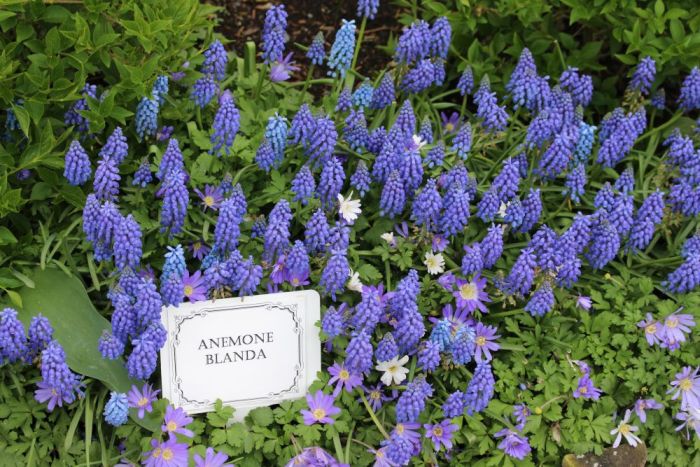
Blue-violet tulips in different lights — shifting between deep purple and unmistakable blue depending on the angle and time of day.
Since true blue is genetically impossible for tulips, the spectrum of what we call "blue tulips" runs from rich violet-blue through cool lavender to deep near-indigo. Understanding where each variety sits on this spectrum helps choose the one that reads most blue in your specific light conditions.
The key insight: in shade, overcast light, or at dusk, violet-blue tulips shift decisively toward blue. The same flower that looks purple at noon can appear genuinely, unmistakably blue in evening light. This optical shift is part of their magic — and why photographers are particularly obsessed with them.
The science behind the impossibility of blue tulips is genuinely fascinating — and understanding it makes the near-blue varieties even more impressive.
True blue flowers rely on a pigment called delphinidin. Tulips' genetic makeup cannot produce it — they simply lack the enzymatic pathway required.
Tulips produce anthocyanins in the red-violet family. By manipulating pH and co-pigmentation, breeders can shift these toward blue-violet — remarkably close, but never chemically blue.
Violet-blue tulips shift toward blue in diffuse or low light because shorter blue wavelengths scatter differently. This is why the same variety looks different at different times of day.
Genetic engineering of a true blue tulip has been attempted but not yet achieved commercially. Delphinidin genes from other species can theoretically be introduced — but not yet to market.
These are the varieties that come closest to true blue — chosen by tulip experts and photographers specifically for how convincingly they read as blue in the right conditions. Each is rated for "blueness" on a five-dot scale.
Blue-toned tulips are the choice for moments and people that deserve something beyond the ordinary. Their rarity makes them inherently meaningful — a gift that says the giver thought carefully and chose something no one else would think of.
Blue-violet tulips follow the same principles as all tulips — but a few specifics help maximise the blue effect and the depth of colour that makes these varieties so distinctive.
Blue-toned varieties look most blue in diffuse or dappled light. Full midday sun warms the colour toward purple — dappled morning light shows the blue at its best.
September–November when soil cools to 50–55°F. Cold dormancy is essential for these varieties to develop their characteristic cool, blue-toned colour depth.
Blue-toned tulips photograph most blue in the blue hour — just after sunrise or before sunset when the cooler colour temperature of the sky shifts violet toward blue.
Like all tulips, blue-violet varieties need excellent drainage. Blue Parrot in particular — with its large, heavy ruffled blooms — benefits from a sheltered spot with perfect drainage.
Blue and yellow are complementary colours — planting blue-violet tulips alongside yellow varieties creates the most visually dramatic contrast possible in a spring border.
Particularly important for Blue Parrot and Blue Diamond — these late-season, heavy-blooming varieties need the full foliage energy cycle to sustain any perennial return.
Blue-violet tulips are among the most rewarding to combine — their cool, unusual colour plays differently against warm and cool tones, always with striking results.
The most dramatic complementary pairing — cool violet-blue against warm yellow creates extraordinary visual tension. The combination that most convincingly makes the blue "pop".
Clean, elegant, and sophisticated — white acts as a neutral foil that makes blue-violet appear even more distinctly blue. Perfect for formal and wedding settings.
Unexpectedly harmonious — cool blue against warm pink creates a romantic, almost watercolour effect. Particularly beautiful with soft blush pink varieties.
A monochromatic blue-violet planting — from near-indigo Blue Parrot through Negrita to periwinkle — creates a dreamy, painterly depth that reads as genuinely blue from a distance.
A regal three-colour combination — the palette of a Flemish painting. Blue-violet with warm gold and crisp white creates something genuinely extraordinary in any garden.